Is Wet Carpet Dangerous? Mold, Musty Smells and Health Risks

When wet carpet becomes a mold and health risk, how long it can safely stay wet, what a musty smell means, and what to do in the first 48 hours.

Wet carpet is not dangerous in itself. The risk is what grows in it if it stays wet. The EPA’s guidance is that water-damaged materials should be dried within 24 to 48 hours, because after that window mold can start to grow. Carpet is hard to dry in that time, because the water that matters sits in the pad underneath, not in the fibers you can touch.

That is why a musty smell after a spill, a leak or a carpet cleaning deserves attention. It usually means moisture stayed in the carpet long enough for mold or bacteria to get started. For most people the effects are allergy-type symptoms; for people with asthma or mold allergies they can be more serious.

Our powder came out of the professional carpet cleaning service we ran in Seattle, so this is ground we know from both sides of the hose. This guide covers how long carpet can safely stay wet, what that smell actually means, when carpet cleaning itself causes mold, and what to do in the first 48 hours after your carpet gets wet.

Table Of Contents

Is Wet Carpet Dangerous?

Short answer: carpet that gets wet and dries within a day or two is usually fine. Carpet that stays damp longer, especially in the pad, can grow mold and bacteria. Those produce allergens and irritants that can affect the people living with them.

The EPA’s guide to mold and moisture is direct about the health side. Molds produce allergens, irritants and, in some cases, potentially toxic substances. Allergic reactions are common and include hay-fever-type symptoms such as sneezing, runny nose, red eyes and skin rash. Mold can trigger asthma attacks in people with asthma who are allergic to it, and it can irritate the eyes, skin, nose, throat and lungs of people who are not allergic at all.

So can wet carpet make you sick? Not directly, but mold growing in carpet that stayed wet can. The risk is higher for children who play on the floor, for anyone with asthma or allergies, and for people with weakened immune systems. If someone in your home has ongoing symptoms you suspect are mold-related, talk to a doctor. That is a medical question, not a cleaning one.

How Long Can Carpet Stay Wet Before Mold Grows?

Infographic diagram showing carpet mold growth timeline from 0 to 48 hours, illustrating that mold begins growing in wet carpet padding within 24 to 48 hours
Carpet Mold Growth Timeline How Long Until Mold Starts After Getting Wet

Can wet carpet cause mold? Yes, if it stays wet. The EPA’s rule of thumb is 24 to 48 hours. If wet materials are dried within that window after a leak or spill, in most cases mold will not grow. The catch with carpet is that “dry” has to mean dry all the way through the pad and backing, not just dry to the touch on top.

What Speeds Up or Slows Down Mold

  • How much water got in. A spilled glass soaks a small patch; a rental machine or a leak can saturate a whole room’s pad.
  • Humidity. Damp air slows drying. The EPA recommends keeping indoor humidity below 60%, and ideally between 30% and 50%.
  • Warmth. Mold grows faster in a warm room than a cool one.
  • Airflow. A closed room with no fan can keep a pad damp for days.
  • What is underneath. Thick pads and carpet over concrete hold moisture longest.
Bar chart showing carpet mold risk levels at different drying times, from low risk under 12 hours to active mold growth at 48 plus hours
How Long Can Carpet Stay Wet Before Mold Risk Chart by Drying Time

Is a Wet Carpet Smell a Health Risk?

Infographic showing that wet carpet musty smell comes from MVOCs released by mold and bacteria, with surrounding icons showing respiratory irritation, headaches, nasal congestion, and elevated risks for children and pets
Wet Carpet Smell Is a Health Risk MVOC Mold Odor and Respiratory Symptoms

The smell itself is a signal more than a hazard, but what it signals can be a health risk. A clean carpet that is still drying smells like nothing much. An earthy, basement-like smell is different. It comes from gases that mold and bacteria give off as they grow, often called microbial volatile organic compounds, or MVOCs. In practice, a musty smell is the earliest sign most people get that something is growing, and it usually shows up before anything is visible.

When the Smell Is a Warning Sign

  • It is still there two or three days after the carpet was cleaned or got wet
  • It comes back on humid days, even though the carpet feels dry
  • It is strongest in one spot, often where a spill, leak or pet accident happened
  • The pad feels damp when you lift a corner of the carpet

Covering the smell with a fragrance or deodorizer does nothing about the cause. The moisture has to come out.

Can Carpet Cleaning Cause Mold?

It can, when the cleaning puts in more water than it takes out and the carpet then dries slowly. Wet cleaning is not wrong in itself, but how wet the carpet is left decides the outcome.

Rental Machines and Spray Cleaners

Consumer rental machines have far less suction than professional truck-mounted equipment, so more of the water and solution they put down stays in the carpet. It is easy to go over the same area several times and soak the pad without realizing it. Spray spot cleaners create the same problem on a small scale: a patch that feels dry on top after an hour can stay damp underneath much longer.

Professional Steam Cleaning

A good technician with proper equipment and drying practices usually leaves carpet dry well inside the safe window. Problems start with over-wetting, weak extraction, humid weather, or closing up a room before it has dried. If you hire a pro, ask how long drying will take and run fans or air conditioning afterward. The IICRC publishes the industry’s cleaning and drying standards.

Why Stains Come Back: Wicking
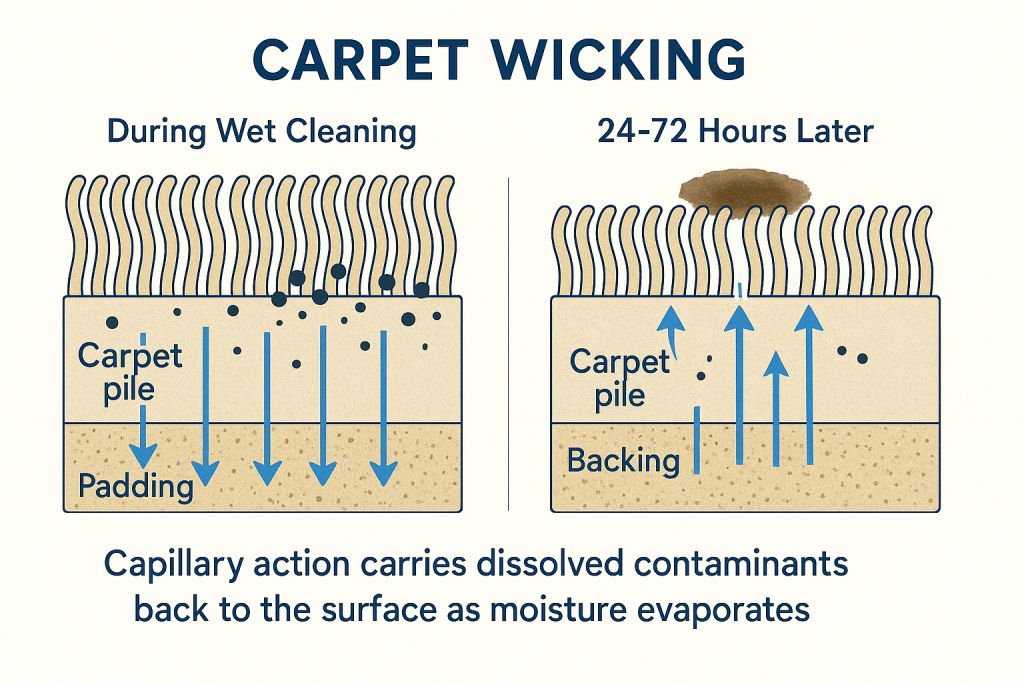
Cross-section diagram illustrating carpet wicking, showing moisture carrying dissolved dirt and stains upward from the padding through the backing to the carpet surface
Carpet Wicking Diagram How Stains Return to Surface After Wet Cleaning

Over-wetting causes a second, visible problem. As carpet dries from the top down, moisture rises through the fibers and carries dissolved soil from the backing back to the surface. A spot that looked gone on cleaning day reappears a few days later. Pet accidents and sugary drinks are the most common culprits. Our guide on removing set-in carpet stains covers what to do when that happens.

Is Wet Carpet Still a Problem After It Dries?

Educational cross-section diagram showing carpet layers with mold growing in the padding beneath the visible carpet surface, with upward arrows showing airborne spores
Hidden Carpet Mold Under Padding Cross Section Educational Diagram

Sometimes. The surface fibers dry first and fastest. The pad underneath dries last, and it is dark, enclosed and absorbent, which is where mold gets established if it gets established at all. Mold under the padding is the kind you cannot see. That is why a carpet can feel completely dry and still smell musty.

If mold does take hold in the pad, cleaning usually cannot fix it. The EPA’s mold cleanup guidance notes that porous materials such as carpet may have to be thrown away if they become moldy, because mold can grow into the spaces in the material and be impossible to remove completely. In practice, replacing the pad, and sometimes the carpet, is the usual fix.

Other Damage From Repeated Over-Wetting

  • Browning. Tan or brown discoloration that appears as the carpet dries, most often on wool or on carpet with a jute backing.
  • Dye bleeding. Some dyes, especially in rugs, run when wet, and the damage is permanent.
  • Delamination. The latex bonding the backing layers can weaken, showing up as ripples or loose areas.
  • Shrinkage and felting in wool and other natural fibers.

What to Do When Your Carpet Gets Wet

The goal is simple: get the carpet and pad completely dry inside 48 hours, faster if you can.

  1. Stop the water. Fix the leak, or deal with the spill right away.
  2. Pull the water out. For a spill, blot hard with dry towels and stand on them. For anything bigger, use a wet/dry shop vac, not a household vacuum.
  3. Move the air. Run fans across the surface, open windows if the air outside is dry, and run a dehumidifier or the air conditioning.
  4. Check the pad. Lift a corner near the wet area. If the pad is soaked, fans on the surface may not dry it in time.
  5. Clean once it is dry, without adding water. A dry cleaning powder lifts the residue and odor a spill leaves behind without re-wetting the area.

For timing, see our guide to how long carpet takes to dry.

What Happens If You Vacuum Damp Carpet?

Warning illustration showing a vacuum cleaner with a red X symbol next to a damp carpet, indicating the dangers of vacuuming wet carpet including motor damage and mold
Warning Do Not Vacuum Damp or Wet Carpet Motor Damage and Mold Risk

Don’t use a regular household vacuum on wet or damp carpet. These vacuums are not built for water. Moisture can damage the motor, create an electrical hazard, and leave the filter and bag damp enough to grow mold of their own. A regular vacuum also does not remove water from the pad, which is the part that matters. Use a wet/dry vac for water, and save the household vacuum for once the carpet is fully dry.

When to Call a Professional

  • The carpet was soaked by a leak, burst pipe or flood, or it has been wet for more than 48 hours
  • The water was dirty, such as sewage, toilet overflow or floodwater
  • You can see mold, or the musty smell persists after everything has dried
  • Mold covers more than about 10 square feet (roughly a 3-by-3-foot patch), or there has been a lot of water damage. Above that size, the EPA’s guidance points you toward professional cleanup

A water-damage restoration company has the extraction and drying equipment to save a pad that a fan will not.

How to Clean Carpet Without Adding Moisture

Step-by-step infographic showing five steps to clean carpet without water using dry cleaning powder: vacuum, apply, brush, wait 30-60 minutes, vacuum out
How to Clean Carpet Without Water 5 Step Dry Powder Cleaning Process

The surest way to avoid every problem above is not to put water into the carpet in the first place. For routine cleaning, a dry cleaning powder does that. The particles absorb soil and oils from the fibers, then come out when you vacuum, carrying the dirt with them.

Our powder, SaniSnow, adds an alcohol-based sanitizer that kills bacteria as it works and evaporates within about 30 minutes. Keep kids and pets off the area during that half hour; once you have vacuumed, the carpet is dry and ready to use. There is no pre-spray and no drying time. You brush it in and vacuum it out.

Powder is for routine cleaning and for dried spills. It is not a fix for a soaked pad or established mold; those need the steps above. For the full range of waterless options, see our guide to cleaning carpet without a steam cleaner. For a direct comparison, see dry carpet cleaning vs steam cleaning and carpet cleaning powder vs liquid shampoo. If you worry about powder and your vacuum, we answer that in which vacuums handle carpet powder.

Visual comparison card showing wet cleaning risks including mold, wicking and fiber damage versus dry powder benefits including no mold risk, no wicking, and immediate carpet use
Dry Carpet Powder vs Wet Cleaning Safety Comparison Mold Wicking Fiber Damage

Quick Check: Is Moisture a Problem in Your Carpet?

  • A musty or earthy smell that lasts more than a couple of days
  • A smell that returns on humid days
  • A pad that feels damp when you lift a corner
  • Stains that reappear a few days after cleaning
  • Brown or tan patches that appeared after cleaning
  • Past leaks, floods or pet accidents in the same spot

One of these on its own is usually a drying problem you can fix with airflow. Several together, or any visible mold, is a reason to lift the carpet and inspect the pad, or to bring in a professional.

Frequently Asked Questions

Yes — and more immediately than most homeowners realize. Wet carpet creates two distinct health hazards. The first is biological: moisture trapped in carpet padding creates ideal conditions for mold and bacteria growth within 24–48 hours. These organisms release MVOCs (microbial volatile organic compounds) that become airborne and cause respiratory irritation, allergy flares, asthma attacks, and chronic symptoms like fatigue and headaches. The second is chemical: many liquid carpet cleaners contain VOCs and harsh chemicals that off-gas into indoor air, adding to the health burden. For families with children, pets, or members with respiratory sensitivities, wet carpet is a legitimate health concern — not just a convenience issue.

The EPA’s guidance indicates mold can begin growing on wet porous materials like carpet padding within 24 to 48 hours of water exposure. That window shrinks in warmer temperatures and higher humidity. For practical purposes, assume any carpet or padding that remains wet for more than 24 hours carries meaningful mold risk. Professional steam cleaning routinely leaves carpet wet for 12–24 hours under ideal conditions — and longer in real-world settings. This is why dry carpet cleaning powder, which introduces zero moisture, is the only method that fully eliminates mold risk.

Yes. Both DIY liquid cleaning and professional steam cleaning (hot water extraction) introduce moisture that can remain in carpet padding for 24–72 hours — well within the 24–48 hour window the EPA identifies as sufficient for mold to begin growing. The mold doesn’t start on the visible carpet surface; it starts in the padding beneath, where moisture lingers longest and airflow is lowest. Many homeowners discover mold under carpet after years of conscientious steam cleaning, having unknowingly created the perfect conditions for it with every cleaning session.

If your carpet smells musty after cleaning — whether immediately or a few days later — it’s a sign that moisture has been trapped in the padding and biological activity has begun. That “wet dog” or earthy smell is the smell of MVOCs released by mold and bacteria metabolizing organic material in your wet carpet padding. This is a health risk signal, not just an odor problem. The only long-term solution is eliminating moisture from your cleaning process. Dry carpet cleaning powder addresses the odor at the source without creating the moisture conditions that cause it to return.

Vacuuming damp carpet is not recommended for two reasons. First, standard household vacuums aren’t designed to handle moisture — it can damage motors, cause electrical issues, and create mold growth inside the vacuum itself. Second, the suction won’t effectively extract moisture from the padding layer, so you’ll be surface-cleaning while leaving the deeper moisture that causes mold. If carpet is wet from a spill, use blotting and airflow (fans, dehumidifier) to dry it first. Once dry, treat with dry carpet cleaning powder to address any residual staining or odor.

Quality dry carpet cleaning powder engineered for household use — like SaniCarpet — is not bad for your vacuum when used as directed. The particles are sized and formulated for complete vacuum extraction. What can harm vacuums are cheap baking soda-based carpet deodorizers, which can cake in filters and damage motors over time. The key difference: professional-grade dry cleaning powder is designed to be vacuumed up; grocery store deodorizers are not always engineered with vacuum safety in mind. Using a properly formulated dry cleaning powder, you should be able to vacuum up all residue in one or two passes with no filter clogging.

Baking soda can absorb some surface odors in carpet, but it has significant limitations. It doesn’t clean or sanitize, it doesn’t remove stains, and it doesn’t address odors embedded in carpet padding — which is where most pet and organic odors actually live. Fine baking soda particles can also accumulate in vacuum filters and damage them over time. For true odor elimination, you need a product that can penetrate carpet fibers, sanitize bacteria (the actual source of most odors), and be fully removed by vacuuming. Professional-grade dry carpet cleaning powder addresses all of these needs where baking soda alone cannot.

Yes — and it often does. Carpet padding is a highly porous material that retains moisture long after the visible carpet surface feels dry. When wet cleaning methods saturate the carpet, that moisture migrates through the carpet face and backing into the padding, where it can remain damp for 24–72 hours. The EPA notes that porous materials like carpet padding that become moldy often cannot be fully remediated — they need to be replaced. This is why repeated wet cleaning is one of the leading causes of the need for early carpet replacement.

Dry carpet cleaning powder is the most effective waterless carpet cleaning method. Here’s the complete process: (1) Vacuum thoroughly to remove loose debris. (2) Sprinkle dry cleaning powder generously over the area. (3) Use a stiff carpet brush to work the powder deep into the fibers with firm, even strokes. (4) Let the powder dwell for 30–60 minutes (longer for heavily soiled areas). (5) Vacuum thoroughly in multiple directions to remove all powder and trapped dirt. The result is clean, dry, immediately usable carpet — with no mold risk, no wicking, and no fiber damage. For spot cleaning, the same process applies: apply powder directly to the stain, brush in, wait, vacuum out.

Water-based carpet cleaning residue is a legitimate concern. The pros: hot water extraction does dissolve and remove a portion of deep-set dirt from carpet fibers, and professional-grade cleaning solutions can break down organic stains effectively. The cons are more numerous: residue from cleaning chemicals remains in carpet fibers after the water evaporates, creating a sticky base that actually attracts new dirt faster; residual moisture causes mold and wicking as described throughout this guide; chemical residues can cause skin irritation and off-gas VOCs into indoor air; and repeated residue buildup accelerates fiber wear. Dry carpet cleaning powder adds no water or detergent. The particles are vacuumed out with the dirt they absorbed, and the small amount left behind is intentional: it helps repel the next stain.

For ongoing home maintenance, dry carpet cleaning is significantly better than wet methods for most families. It eliminates mold risk (the #1 concern with wet methods), prevents wicking so stains don’t reappear, extends carpet lifespan by protecting fibers and backing, costs a fraction of professional steam cleaning, and requires no drying time. The only scenario where wet methods hold an advantage is very deep-set contamination from severe flooding or long-term pet saturation — situations that typically require professional remediation equipment regardless. For routine cleaning, spot treatment, and maintenance, dry powder delivers equivalent or superior results without any of the drawbacks.

The Bottom Line

Happy family with young children sitting together on clean bright carpet in a sunlit living room, representing a safe healthy home environment free from carpet mold and chemicals Keywords: safe carpet cleaning for families, non-toxic
Happy Family Enjoying Clean Safe Carpet with No Mold or Chemical Risks

Wet carpet becomes a problem when it stays wet. Dry it completely within 24 to 48 hours and in most cases nothing grows. Take a musty smell seriously, check the pad, not just the surface, and call a professional for soaked pads, dirty water or visible mold.

For everyday cleaning, the simplest way to stay out of that window entirely is to clean without water at all.

Learn more about our dry carpet cleaning powder, SaniCarpet, and more helpful carpet maintenance tips.

Now Available!

SaniCarpet SaniSnow Dry Carpet Cleaning Powder

SaniCarpet Dry Carpet Cleaning Powder

Our official in-home use dry carpet cleaning powder to keep your carpets clean, fresh, sanitized, protected, and dry! 

Use it for general cleaning, spot, stain, pet mess, and spill treatment to prevent carpet wicking!

Purchase Online Today!

author avatar
SaniCarpet
Scroll to Top